
Oblique Crunches: 11 Best Oblique Exercises (With Videos)
Want defined abs and that strong, athletic look? It’s time to stop overlooking your obliques.
Oblique crunches and side crunches are more than just a waist-sculpting move, they’re your secret weapon for better posture, stronger lifts, and improved performance in sports that demand power and rotation.
In this guide, we’ll show you how to target your obliques effectively, break down the best crunch variations, and explain exactly why they deserve a spot in your core routine.
Table of Contents:
- Oblique Crunch (Side Crunch)
- Oblique Crunches (Each Side)
- Oblique Crossover Crunch
- Lying Oblique Crunches
- Lying Oblique Side Crunch With Leg Over
- Standing Cable Oblique Crunch
- Stability Ball Side Crunch
- Decline Oblique Crunches
- Reverse Oblique Crunch
- Bent Leg Reverse Oblique Crunch
- Hanging Knee Raise Oblique Crunch
What Are Oblique Muscles?
The obliques consist of both internal and external obliques and are responsible for the twisting of your trunk and provide support to your spinal column when moving and stabilise your core.

What Are Oblique Crunches?
The oblique crunch exercise is traditionally a bodyweight movement that works both the internal and external obliques through rotation and torque by lifting or “crunching” your upper body towards your lower body or vice versa.
11 of the Best Oblique Crunches?
Firstly, there are several variations on how to do the oblique crunch exercises on the floor and methods utilising equipment. We will show you variations and progressive forms of the exercise that you can strive for or include in your next oblique workout.
Let’s start with the most recreational way most gym-goers perform the oblique crunch:
1. Oblique Crunch (Side Crunch)
Set-Up: You just need an exercise mat or a soft floor to perform this exercise on.
Starting Position:
- Lie down on the floor or mat in a conventional sit-up position with legs at roughly a 90-degree angle and feet planted on the ground. Do not let your feet come up during this exercise.
- Place your hands behind your head on either side to support your neck through the movement and keep your elbows pointing out.
- Do not pull your head forward and keep your chin off your chest when performing the side crunch.
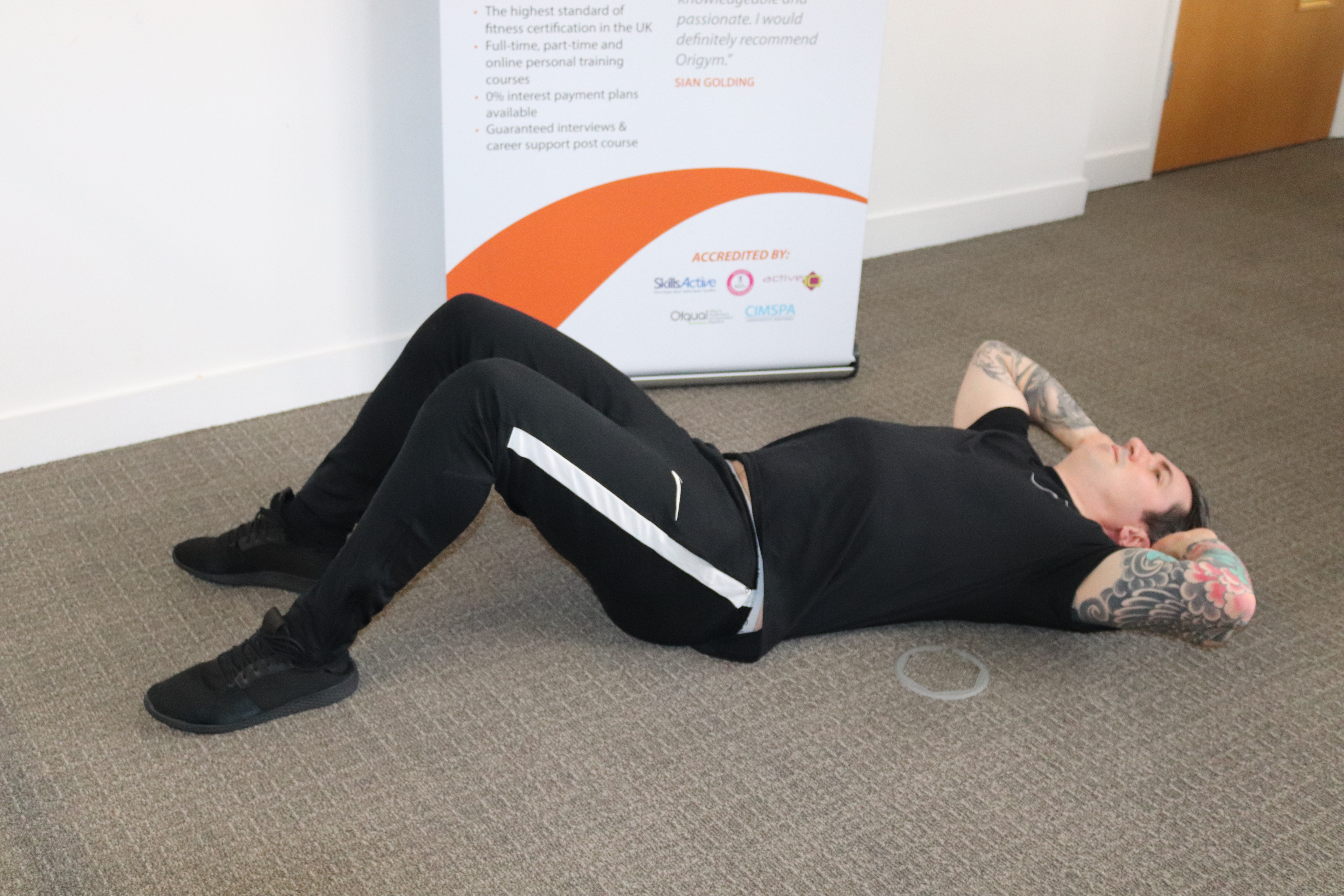
Execution:
- Take a big breath in and engage your core.
- Lift your right shoulder blade off the floor and then drive your elbow in the direction of your left knee.
- Remember to keep your chin off your chest and not pull your head and neck.
- Squeeze at the top of the movement and then slowly release back to the starting position. Remember that you are driving across your body, not up and across, that is a sit-up with a twist, not a crunch.
- Repeat the movement until the desired number of repetitions has been completed and then repeat on the other side.
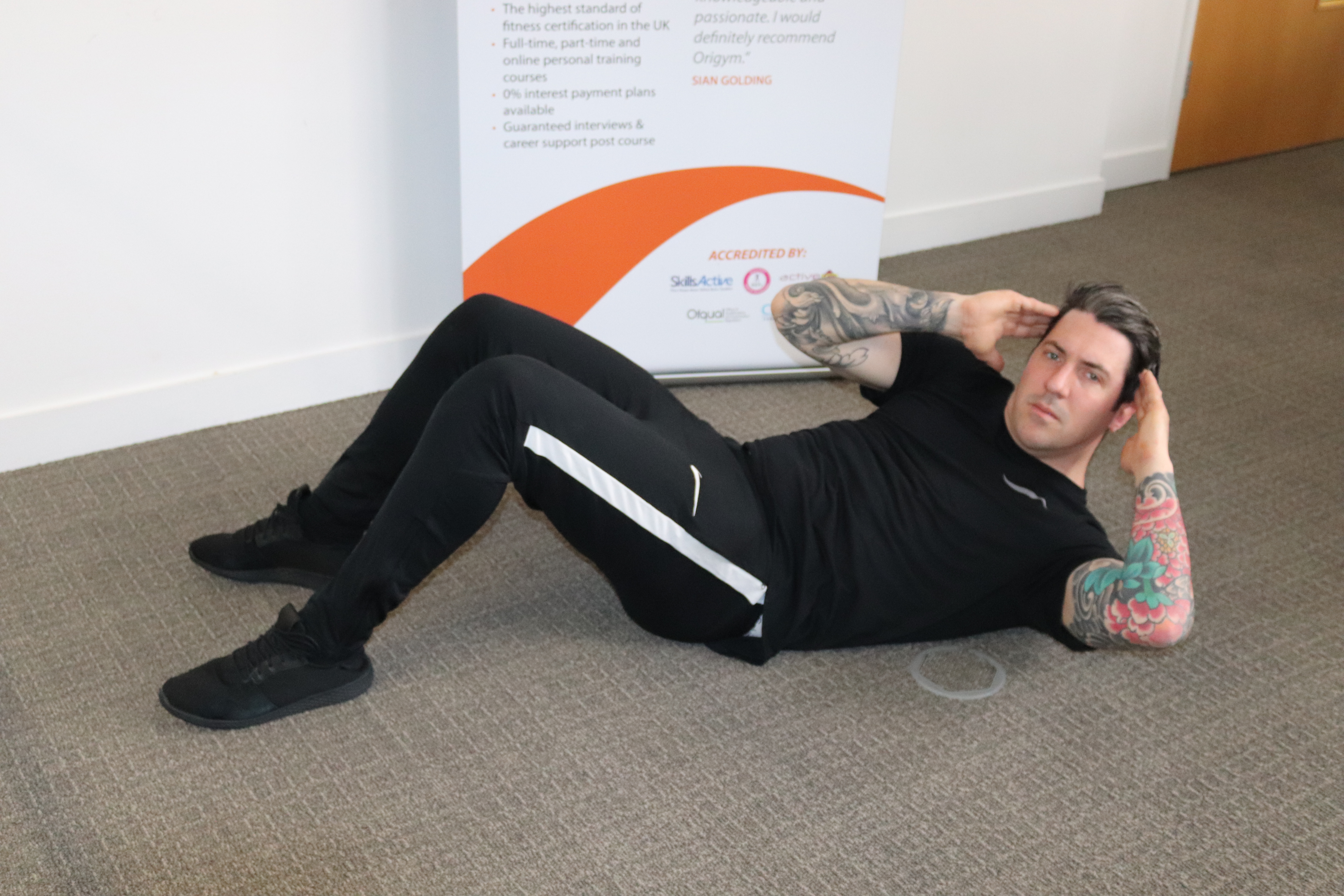
2. Oblique Crunches (Each Side)
If you prefer to focus on each side of your obliques alternately, much like you might with dumbbell bicep curls, then you adapt the exercise above using the following steps.
Starting Position:
- Set up and get into position in the exact same manner as the single side oblique crunch with your back on the floor and feet firmly planted at a 90-degree angle.
Execution:
- Again, take a breath, engage your core and lift your right shoulder blade off the floor and drive your elbow in the direction of your left knee.
- Once you have returned slowly and in a controlled manner back to the starting position following the same angle of rotation, repeat the movement lifting your left shoulder blade and driving towards your elbow towards your right knee.
- Remember to breathe out as you’re contracting and to control the motion on the way back to the starting position.
3. Oblique Crossover Crunch
Another side ab crunch is the oblique crossover crunch. Many gym-goers opt to cross their leg over, hence the name, to give them more of a directional motivation when executing the movement. This exercise does not really possess any greater benefit or progression than the side crunches mentioned above.
Starting Position:
- To start the oblique cross-over crunch, lie flat on your back with your body facing the ceiling.
- Cross your left leg over your right thigh
- Rest your right hand on the side of your right temple or the side of the back of your head.
- Rest your left hand on the middle of your stomach (this is to remind you to contract and feel your stomach as you crunch up)
Execution:
- Tense your abs and crunch over (not up and over) and across your body so that your right elbow touches the inner left knee (exhale your breath as you do this)
- Once your elbow and knee make contact, pause in the top position for one second and squeeze your abs as hard as possible
- As with all oblique floor crunches, slowly lower yourself back down (whilst inhaling)
- Return to the starting position
- Repeat for the desired number of repetitions before switching sides.

Image Credit: Nick, Founder of LEP Fitness.
If you’re enjoying this article, why don’t you give these a read too?
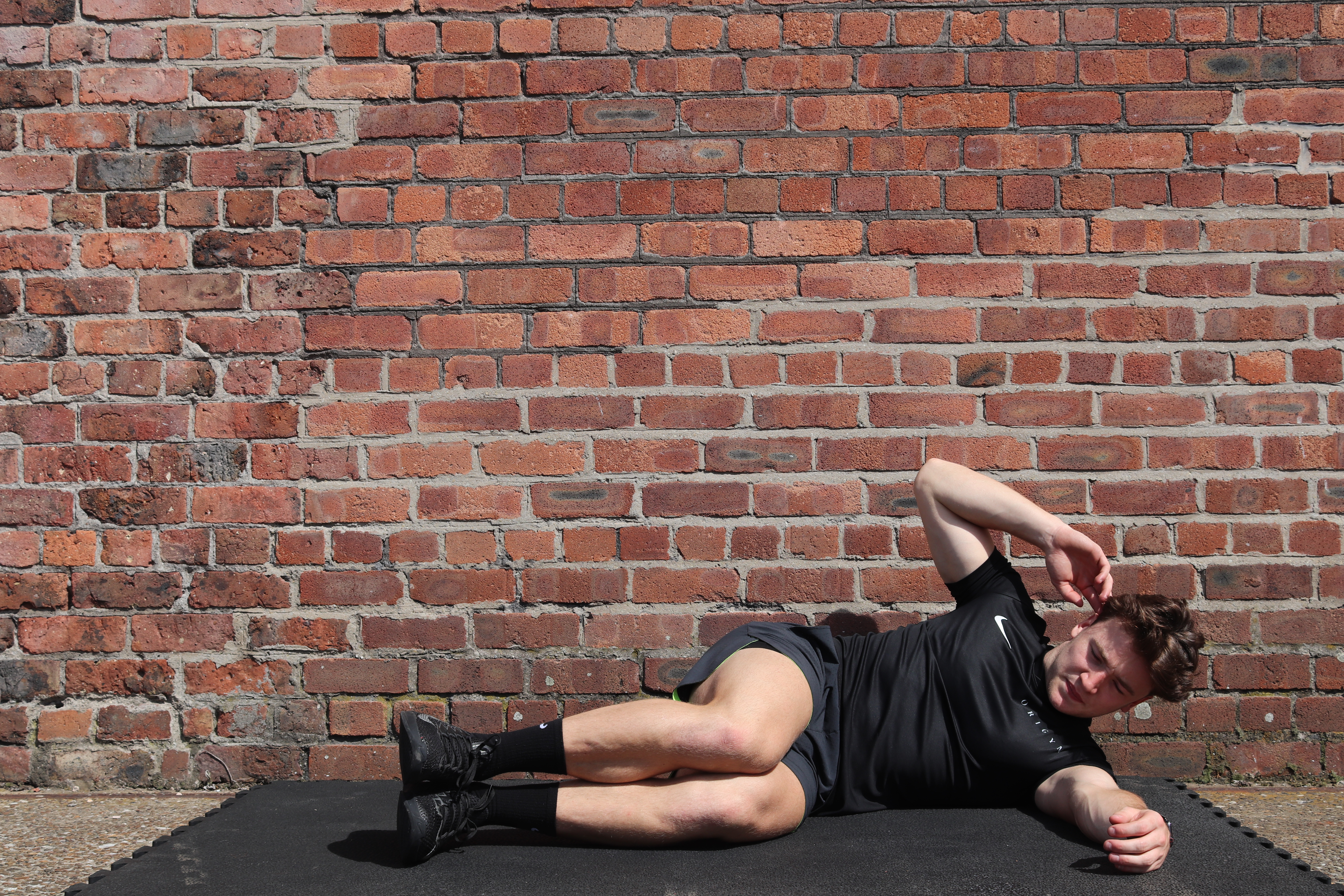
4. Lying Oblique Crunches
Another floor oblique crunch is the “lying side crunch” or the “lying oblique crunch” as it’s sometimes known. This variation isolates the obliques you’re trying to target more than the above variations and is considered by many trainers as safer for your spine and more controlled as it’s a lateral movement as opposed to a vertical one.
Set-Up: You just need an exercise mat or soft floor to perform this exercise.
Starting Position:
- Lie down on your left-hand side with both knees bent at roughly a 45-90-degree angle to your body for support.
- Place your right hand on the right side of your temple.
- Rest your left arm on the floor and keep it straight and relaxed.
- Engage the right-hand side of your core and you’re ready to start the movement.
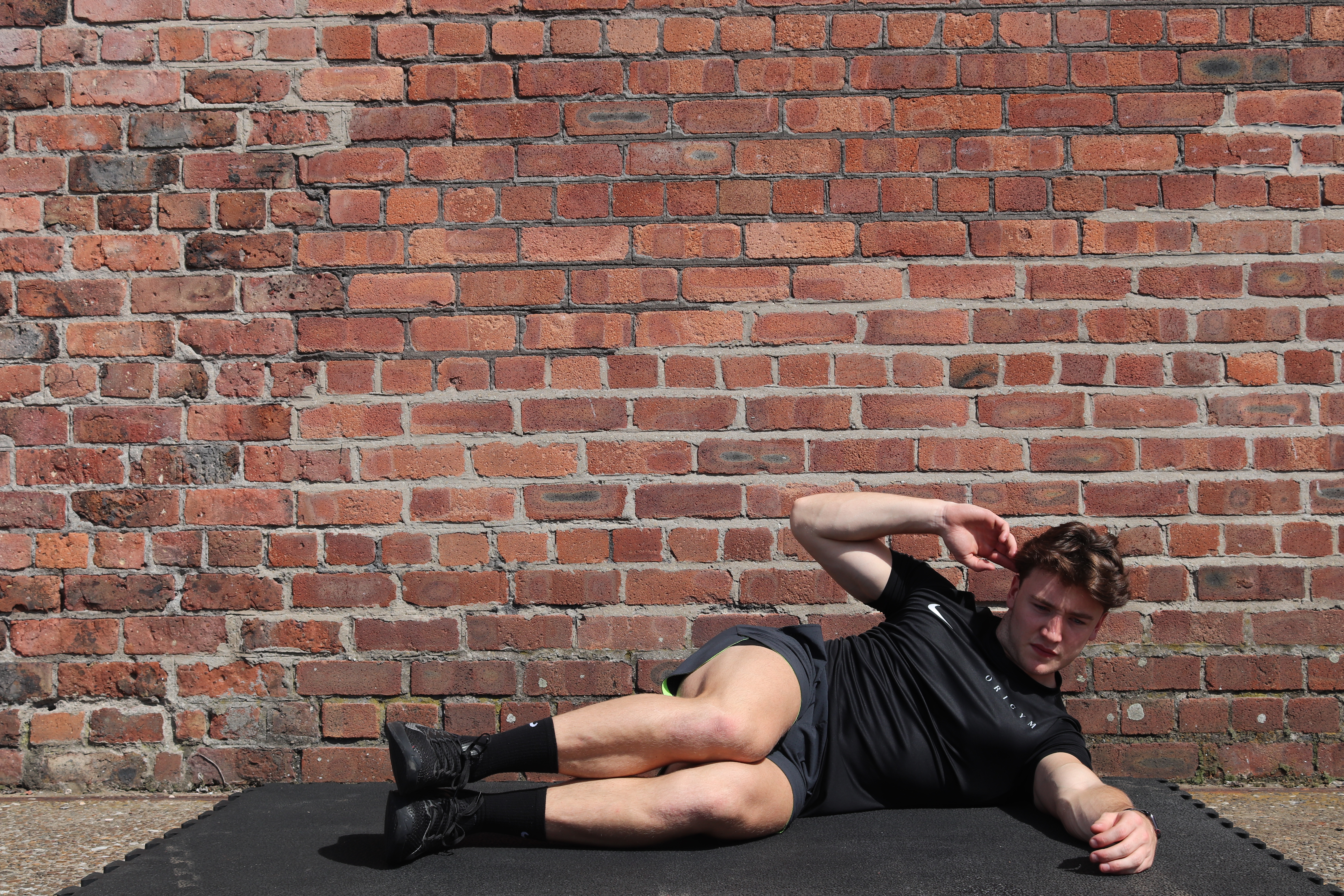
Execution:
- To complete this side crunch exercise, contract the right side of your abdominals whilst bringing your elbow towards your outer thigh.
- As you contract up, slowly exhale.
- Pause in the top position, and contract your abs as hard as you can, hold the contraction for one second before slowly lowering back to the starting position, inhaling your breath on the way down
- Once you’ve completed a repetition, repeat for the desired number of repetitions and then switch sides.
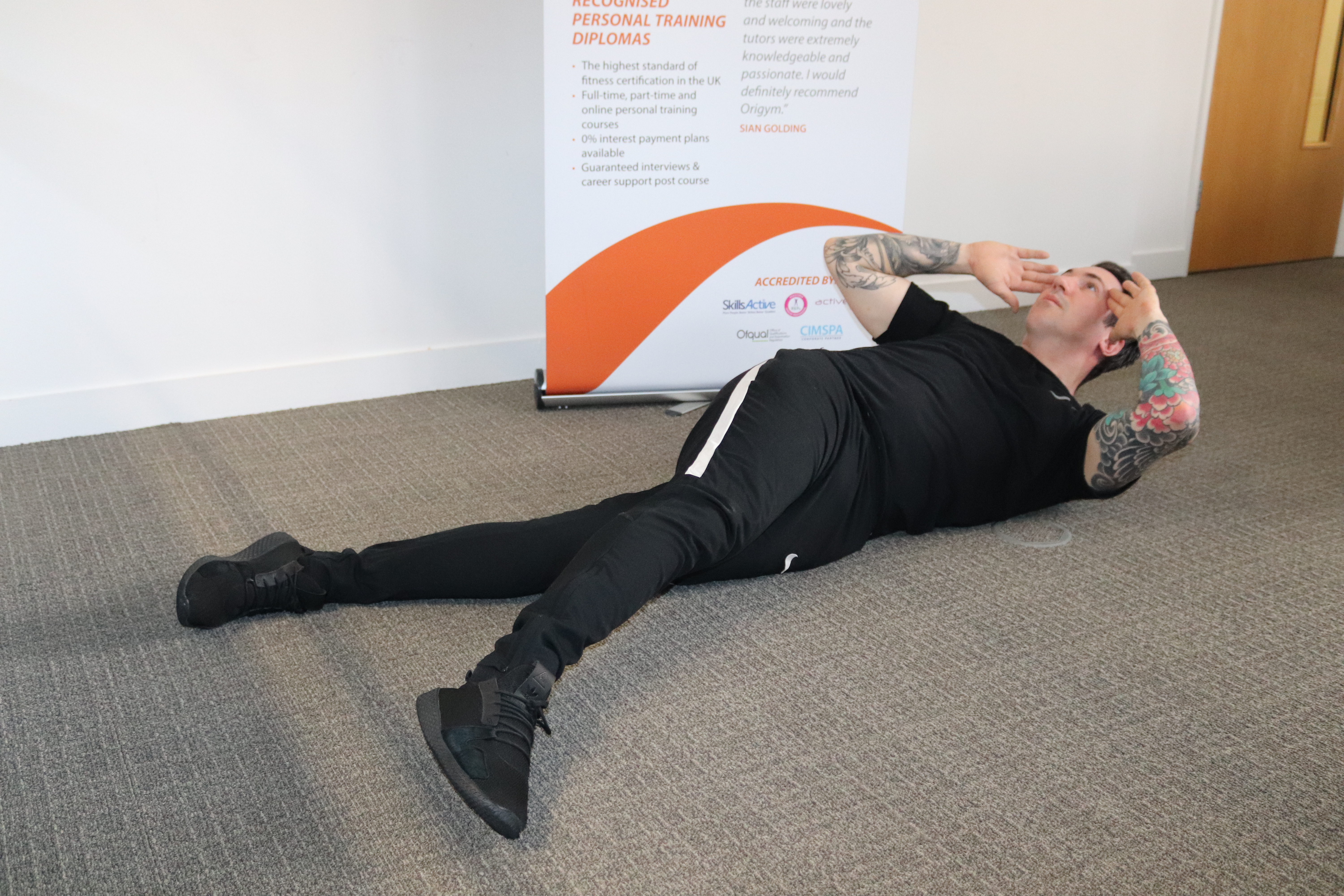
5. Lying Oblique Side Crunch With Leg Over
This floor oblique crunch is a good alternative exercise if you struggle to maintain keeping your legs relaxed and feet planted on the floor when performing a conventional oblique crunch.
Starting Position:
- Lie down on your mat with your back on the floor with legs extended
- Whilst keeping your upper body and head fixed, lift your right leg up and extend all the way over your left leg as far as you can go to give yourself a wide base of support
- Place your left hand on your thigh for support and to help sustain your position.
- Place your right hand behind the right-hand side of the back of your head.
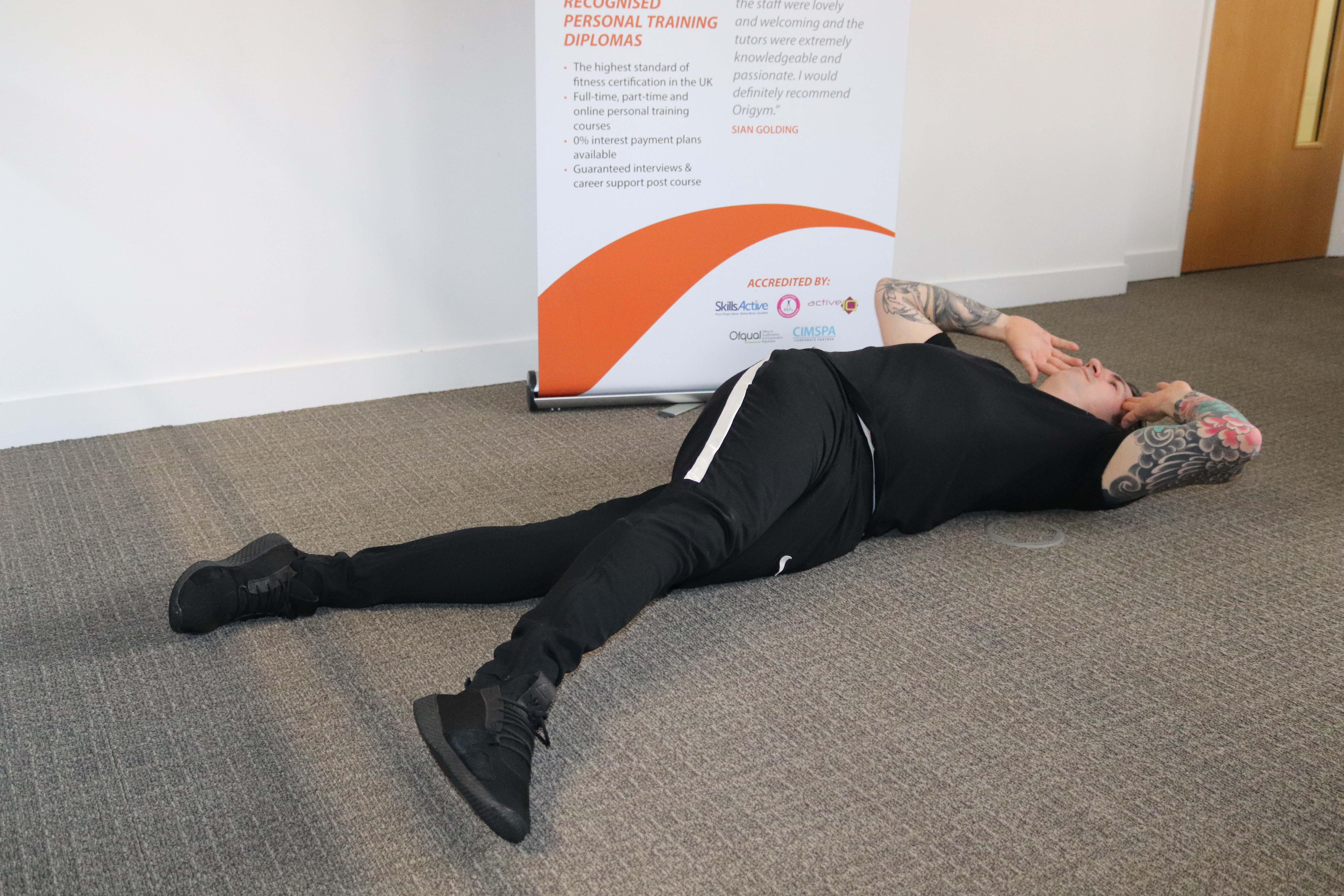
Execution:
- Whilst maintaining a neutral spine, keeping your core tight and focusing on a point on the ceiling, drive upwards, lifting your right shoulder blade and trap off the floor (do not curl over).
- Remember to exhale when you contract and inhale during the controlled lowering phase of the exercise.
- Repeat this movement for the desired number of repetitions before switching sides.
6. Standing Cable Oblique Crunch
The standing oblique cable crunch is a nice variation to include in your oblique workout and a good way to increase the levels of resistance than oblique bodyweight exercises. This exercise is all about form and technique and needs to be practised to gain the full benefit from it. It can act as part of a superset, or the weight can easily be changed as a drop set.
Set-Up:
For the oblique cable side crunch, you will need a high cable machine. Set it up as per the instructions and decide which weight you are going to use. We suggest building the weight up incrementally rather than starting on your maximum pull. That way you can avoid injury and focus on form.
Starting Position:
- Grip the handle with your dominant hand and face your body at a right angle to the pulley.
- Keep your feet firmly on the floor and shoulder-width apart.
- Your forearm should be at a right angle to your upper arm.
- Engage your abs, and for extra intensity, squeeze your shoulder muscles.
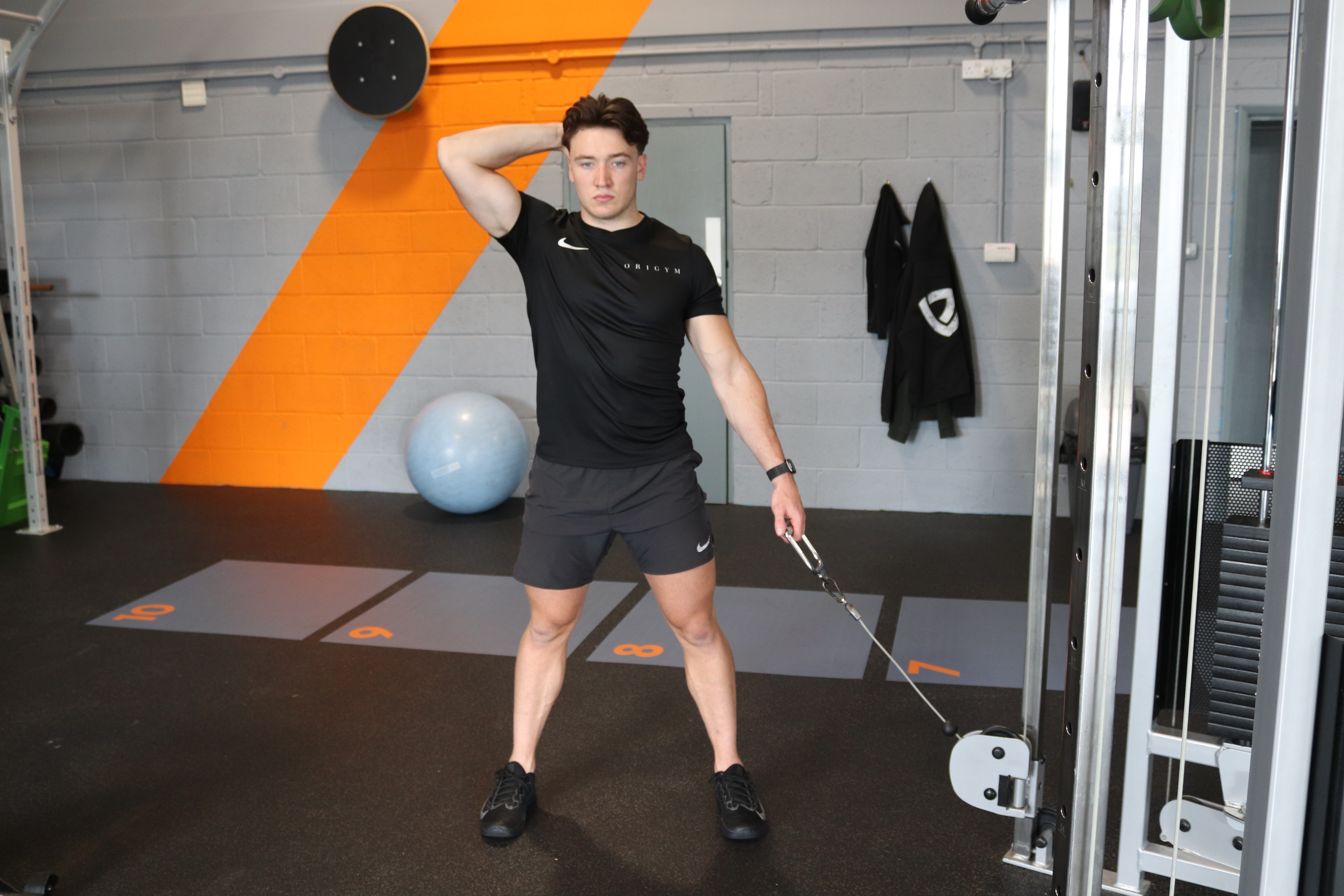
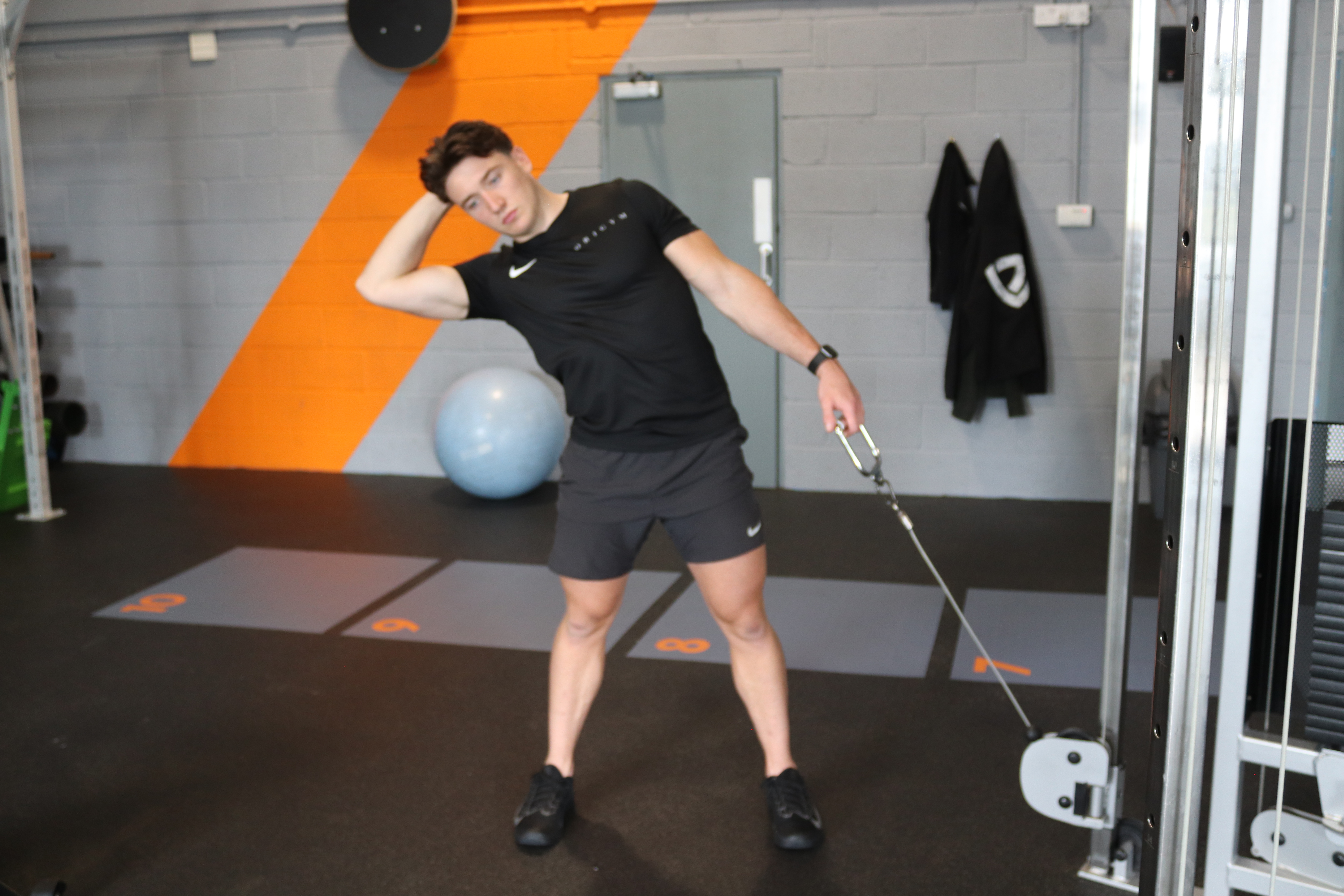
Execution:
- Pull straight down on the weight using your obliques. Ensure you do not go too low.
- When you get to the optimum point for you, which is usually towards the hip where you feel the pressure within the abs, pause for a second.
- Then bring your arm back up in a controlled manner to the starting position.
- Exhale on the pull, inhale on the raise.
- Carry out your reps on one side of your body and then switch sides. Alternatively, you can complete these side oblique crunches in an alternative format if you wish, but ensure you sustain control when switching between sides.
Progressive Oblique Crunches
Once you have learnt how to do the oblique crunches mentioned above, start moving on to more complex oblique crunch exercises like the ones below that will challenge your core more, increase more muscle fibre activation and ultimately get you better results in the long run.
7. Stability Ball Side Crunch
Once you have mastered some of the floor oblique crunches, a form of progression would be to attempt the stability ball side crunch, which places a higher demand on your core and stabiliser muscles to remain in position and execute the movement.
Set-Up: For this side crunch exercise, you will need a stability ball and you can start off by setting yourself near a wall with a little leg room on one side.
Starting Position:
- To get into the starting position, place the stability ball a few feet away from the wall and place your left hip on the ball.
- Extend your legs out for support with your right leg fully extended and your foot facing forward at a 90-degree angle flat on the floor.
- Your left leg should be back to increase your base of support and not fully planted.
- Place your right hand either fully out or behind your head and place your left hand on the Swiss ball for extra support.
Oblique Crunches on a Stability Ball Execution:
- To execute Swiss ball oblique crunches, lift your body off the ball in a straight line over your hip.
- Ensure to keep a neutral spine, your head facing forward and do not let your shoulders rotate.
- Breathe out as you contract and then take a big breath in as you lower in a controlled manner back to the starting position.
To make this stability ball oblique crunch harder, you can move your hips further up the ball and then extend your arms out so that when you lower your body your fingertips can almost touch the floor. This will increase the range of motion and challenge your obliques and core muscles even further.
8. Decline Oblique Crunches
Decline bench oblique crunches increase the range of motion by comparison to oblique crunches on the floor, as your body goes through a larger range of motion and thus your obliques are under more stress and tension.
Set-Up:
This exercise is usually performed at the gym because it needs an exercise bench and most preferably a decline bench. If you have an exercise bench at home, however, you will be able to do this side crunch exercise without leaving the house.
Make sure you have the bench set at a decline angle that you feel comfortable with. You can start with a slight decline and progress to steeper angles once you have adapted to the exercise.
Starting Position:
- The starting position for the decline twisting crunch is to slowly lower your back on the bench, ensuring that you keep your back flat against the bench.
- Wrap your feet around the supports underneath to stop yourself from slipping. You might be able to hook your toes behind the bar underneath, depending on how secure you feel.
- You are now in the starting position for the decline oblique crunch and are ready to begin.
Execution:
- To execute, lift your right shoulder blade off the bench and then drive your right elbow in the direction of your left knee.
- Remember, you are not curling up, you’re curling across your body.
- You can put your hands behind your head as you do with other crunches or place one hand on your hip if you prefer. Do not utilise them to pull yourself upwards, they are there to prevent you from using your arms to create momentum.
- Once you have pulled yourself up and over, squeeze for a brief moment before controlling the eccentric contraction back to the starting position.
- Allow your body to fully extend at the bottom of the movement before attempting another repetition and remember to breathe throughout the movement.
- Complete these decline bench oblique crunches each side at a time or rotate sides in between repetitions.
Decline side crunches are difficult; however, you can make them even harder by extending your arms out in a straight line, above your head to shift your centre of gravity further away from your point of axis. Alternatively, you can simply add weight in the form of a plate or medicine ball by placing it on the side of your chest you’re crunching and then progressing to placing it in your hands that are extended above your head.
9. Reverse Oblique Crunch
A reverse oblique crunch targets the lower portion of your abdominals while engaging your obliques through a controlled, twisting motion. It’s a great addition to any core workout for strengthening the entire abdominal wall.
Set-Up:
- Lie on your back on an exercise mat or soft surface.
- Place your arms down by your sides, palms facing the floor for support.
- Bend your knees to about 90 degrees and lift your feet off the ground so your thighs are perpendicular to the floor.
Starting Position:
- Engage your core and press your lower back into the ground.
- Keep your knees together and your feet fixed.
- Slightly lift your hips off the mat, prepare to twist as you crunch.
Execution:
- Exhale and contract your abs to lift your hips off the floor.
- As you lift, twist your knees to one side, aiming them towards your oblique muscles. Focus on using your core, not momentum.
- Slowly lower your hips and legs back to the starting position with control.
- Repeat the movement, alternating sides with each rep.
Aim for 10-15 reps per side, 3 sets total. Focus on slow, controlled movements to maximise oblique engagement.
10. Bent Leg Reverse Oblique Crunch:
Starting Position:
- Lie down on the floor with your arms down by your side and your knees bent at roughly a 90-degree angle and feet together. If you feel more comfortable you can place your arms out wide to increase your base of support.
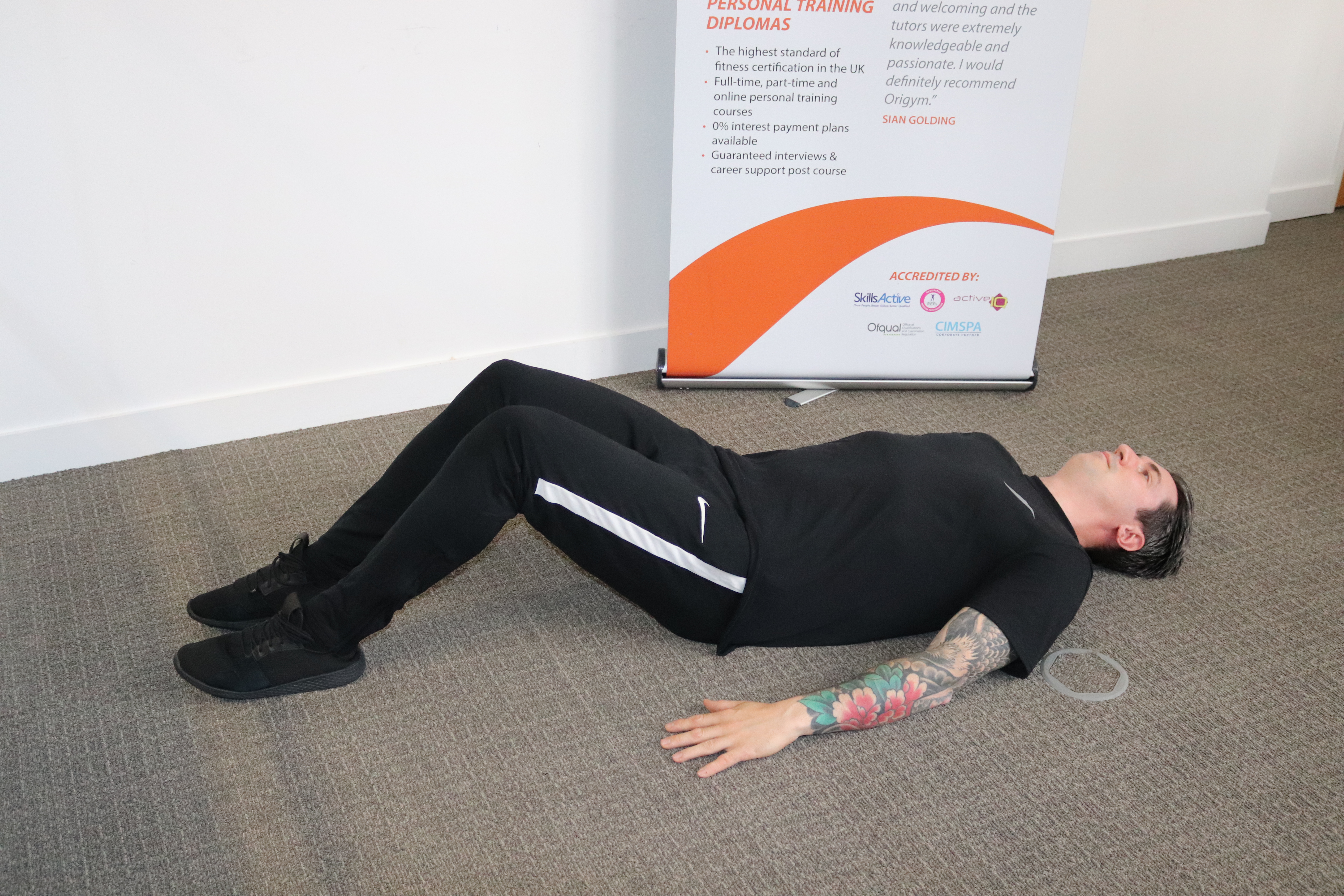
Execution:
- Take a big breath in and engage your core.
- Lift your legs off the floor whilst ensuring there is no rotation in your head, torso or shoulders and drive your right near in the direction of your left shoulder.
- Squeeze at the top of the movement, exhale as you contract your obliques.
- Slowly lower your legs back down to the starting position but ensure your feet do not touch the floor before repeating the next repetition to maximise tension on the muscles.
- You can complete the reverse oblique crunch on one side or alternate between repetitions.
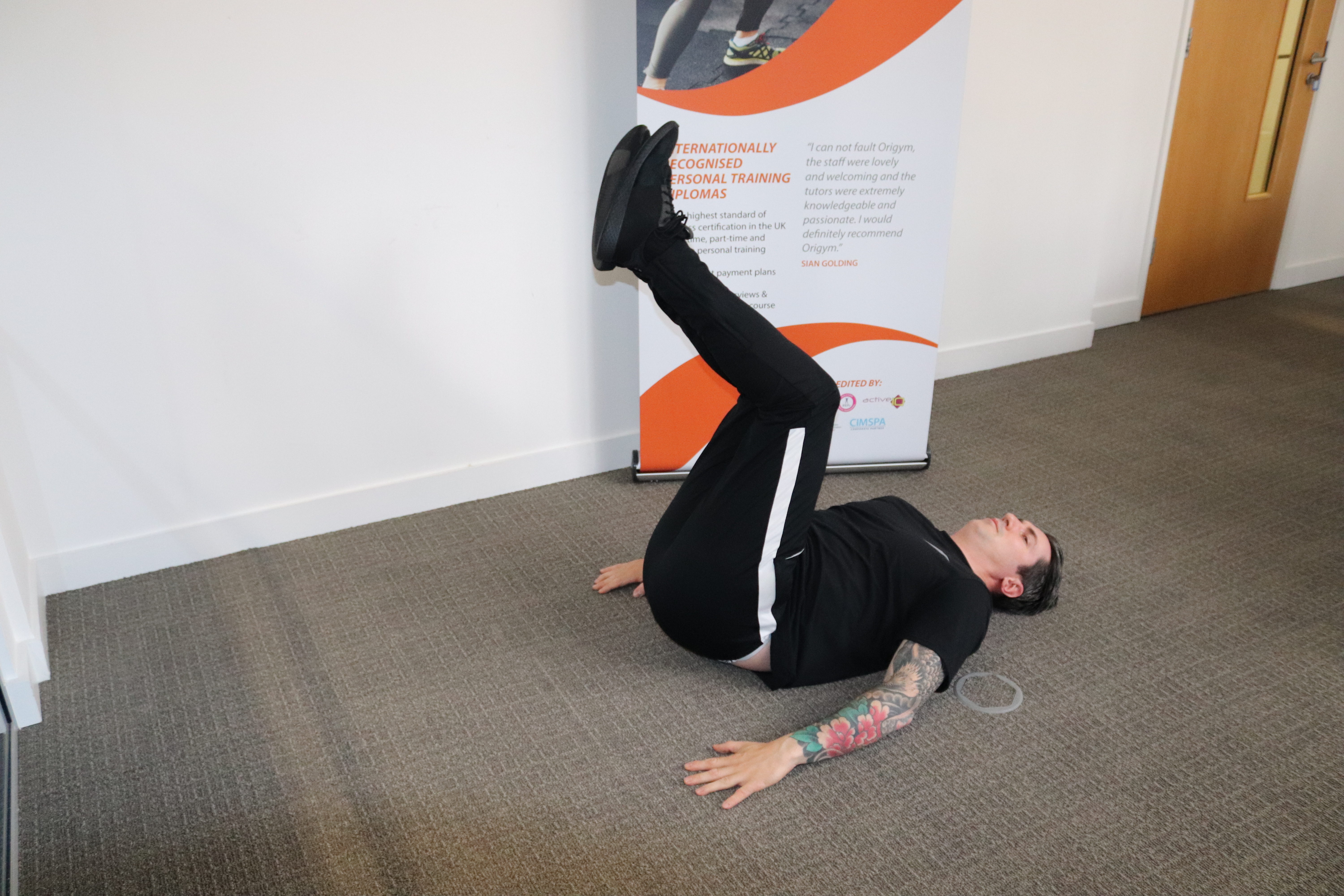
If you want to make the reverse oblique crunch more challenging, try extending your legs out like in the video below:
11. Hanging Knee Raise Oblique Crunch
Saving the hardest until last, the hanging knee raise oblique crunch is an advanced movement for seasoned trainers that works the obliques, hip flexors and abdomen all in one movement.
Set-Up:
For this exercise, you will need a bar that is the correct height for you. It must be above your head and able to support your total weight, including being stable enough so that when you raise your legs off the floor it will remain in place and not flex. A chin-up bar works fine.
Starting Position:
- Stand directly beneath the bar so that it is positioned high above your head.
- Jump up, grip the bar overhand to give yourself more stability, with your hands in line with your shoulders. Hang with your feet facing forward.
- Take a big breath in and engage your abdominals and focus on preparing for your first raise.
Execution:
- Raise your legs out in front of you and bend your knees at a 90-degree angle with legs together and toes pointed.
- Pull your knees up and across to one side of your body, allowing your hips to rotate until your toes are perpendicular to the floor.
- Aim to move your knees up so that your knees almost touch your chest and squeeze at the top of the movement. Whilst crunching, exhale.
- When you lower your legs, do not straighten them. Inhale on the release, keep your legs bent at the knee and complete as many reps as you can. The hanging oblique knee raise can be completed by doing reps on one side and then repeating or by carefully switching sides after each repetition.

Benefits of Oblique Crunches and Side Crunches
Incorporating oblique crunches and side crunches regularly into your core routine offers a range of physical and functional benefits beyond just aesthetics.
- Improves Posture and Balance: Strengthens your core and stabilisers for better alignment and coordination, especially in rotational sports like swimming or cricket.
- Stronger Core and Lower Back: Engages the full abdominal wall and supports spinal health, reducing injury risk.
- Boosts Functional Strength: Makes everyday movements like carrying shopping or twisting to reach objects easier and safer.
- Increases Flexibility and Range of Motion: Enhances your range of motion for both workouts and daily activities.
Oblique and side crunches go beyond aesthetics, they help build a strong and functional core.
Before You Go!
Ready to turn your passion for fitness into a career?
Before you go and put these side ab crunches into practice, check out OriGym’s recognised personal training diploma or download our course prospectus.
Big thanks to Nick, head trainer and founder at LEP Fitness, for contributing his expert insights in this guide.